
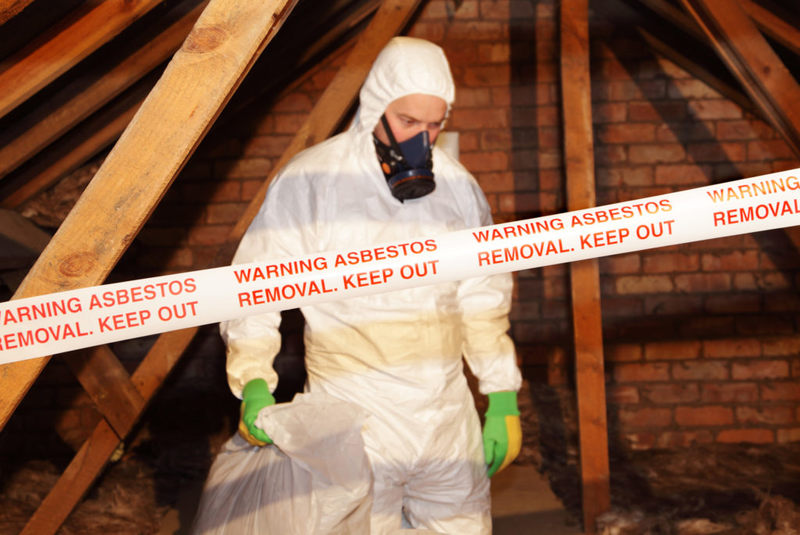
Asbestos Sampling and Removal
Asbestos can have harmful effects on you and your family, some of which are lethal – so it’s best to have your home checked out by a Rainbow International professional technician before the material becomes airborne.
Asbestos is a naturally occurring silicate material that was once widely used in the building sector in the UK- you could well have it hiding somewhere inside your property, especially if your home was built before 2000. If you are unsure about the amount of asbestos in your home; it’s best, however, to put your mind at rest and hire a Rainbow International specialist technician to carry out asbestos sampling.

Increasingly house purchasers are wanting to know if their new home is going to be a safe place to live, and conveyancing solicitors and mortgage providers are wanting asbestos information as part of their lending criteria. You would probably also want to know if you were buying into potentially expensive asbestos removal works in the future.
As far as the Control of Asbestos Regulations are concerned, a full asbestos survey will be needed as soon as you employ someone such as a builder, plumber or electrician, to carry out any work which could disturb asbestos materials and cause harm.
Rainbow International can offer a speedy and cost efficient service for home owners or prospective purchasers requiring asbestos sampling.
How To Identify Asbestos In Your Home
If you want to locate the asbestos yourself to save time, fraying or peeling, or an accumulation of dust on walls is usually a clear sign; do not, however, disturb the area. Asbestos is extremely dangerous and can be found in a number of obscure places in the home, including:
- Thermal and acoustic insulation
- Walls, partition walls and ceiling linings or tiles
- Attics and cement roofing
- Drain pipes and guttering
- Floor tiles and bath panels
- Ventilation ducts
- Insulation boards
- Electrical fuse boards and switch gear
- Toilet cisterns and water tanks

Asbestos Sampling
The Rainbow Technician will probably take one or more ‘extracts’ from various rooms in the property in a specially designed double sealed bag to be analysed at an approved laboratory for chemical testing, that way you will be 100% certain about the level of asbestos in your home.

Once the type and strength of the asbestos found in the property is determined (or if its presence is in fact refuted), you can choose whether or not to have the material removed or merely encapsulated (a less expensive method whereby the material is encapsulated into a protective adhesive). The Rainbow Technician will be able to advise the preferable course of action depending on the potential impact of the asbestos found.

About Asbestos
Asbestos is a naturally occurring mineral made up of microscopic fibres.
It is still mined today in countries such as Russia, India, China and Kazakhstan. In the late 19th century, asbestos became popular because it is incombustible, and because of its resistance to heat, electricity and chemical damage, its sound absorption and tensile strength. It was therefore made into, or added to, many different building materials to take advantage of these properties, such as fire-retardant sprays & coatings, pipe & boiler lagging, boards, cement, ropes & cloths, textured coatings such as ‘Artex’, gaskets, etc. Literally, thousands of different products have had asbestos added to them.
Three main types of asbestos have been used in the UK – Chrysotile, Amosite and Crocidolite (white, brown and blue). But why is it so harmful? Imagine asbestos mineral fibres as microscopic needles. If a person were to breathe those needles in, they would travel far down into the lungs and become lodged in the lung tissue.
These fibres can cause serious diseases which are responsible for over 4000 deaths a year in the UK. There are four main diseases caused by asbestos: mesothelioma (always fatal), lung cancer (almost always fatal), asbestosis (not always fatal but very debilitating) and diffuse pleural thickening (not fatal). Crucially, asbestos related diseases don’t generally present until 10 to 50 years after exposure, and HSE figures show that more people die in the UK from the effects of asbestos exposure than die from road traffic accidents.
The use, importation and sale of asbestos was finally banned in the UK in 1999, but this means that any building in the UK constructed prior to November 1999 might contain asbestos.
However buildings constructed after 1992 which came under the CDM Regulations umbrella, should have a health and safety file which should give details of any asbestos containing materials used. However unless the H&S file clearly states that no asbestos products were used it must be presumed that the building is liable to contain asbestos materials.
If you want more information, or to talk through any concerns you may have, please contact Rainbow International, Canterbury.